Shared gallery state
src/state/gallery.jsModule signals hold filters, canvas seed, drawing mode and the selected research slug.
Creative starter
An editorial research lab site exploring artificial intelligence and visual culture.
Four distinct authored research dossiers present questions, methods, specimens and limits. The shared seeded instrument is described honestly, with a clearer mobile accession heading and adjacent navigation.
This tracks the recorded release phase. The checks below include later findings and ongoing refinements.
The following describes the intended reference. Features are not a verification claim; recorded check results below define what has actually been tested.
Client-rendered application served from explicit static route entries; browser-local state, not a shared server database.
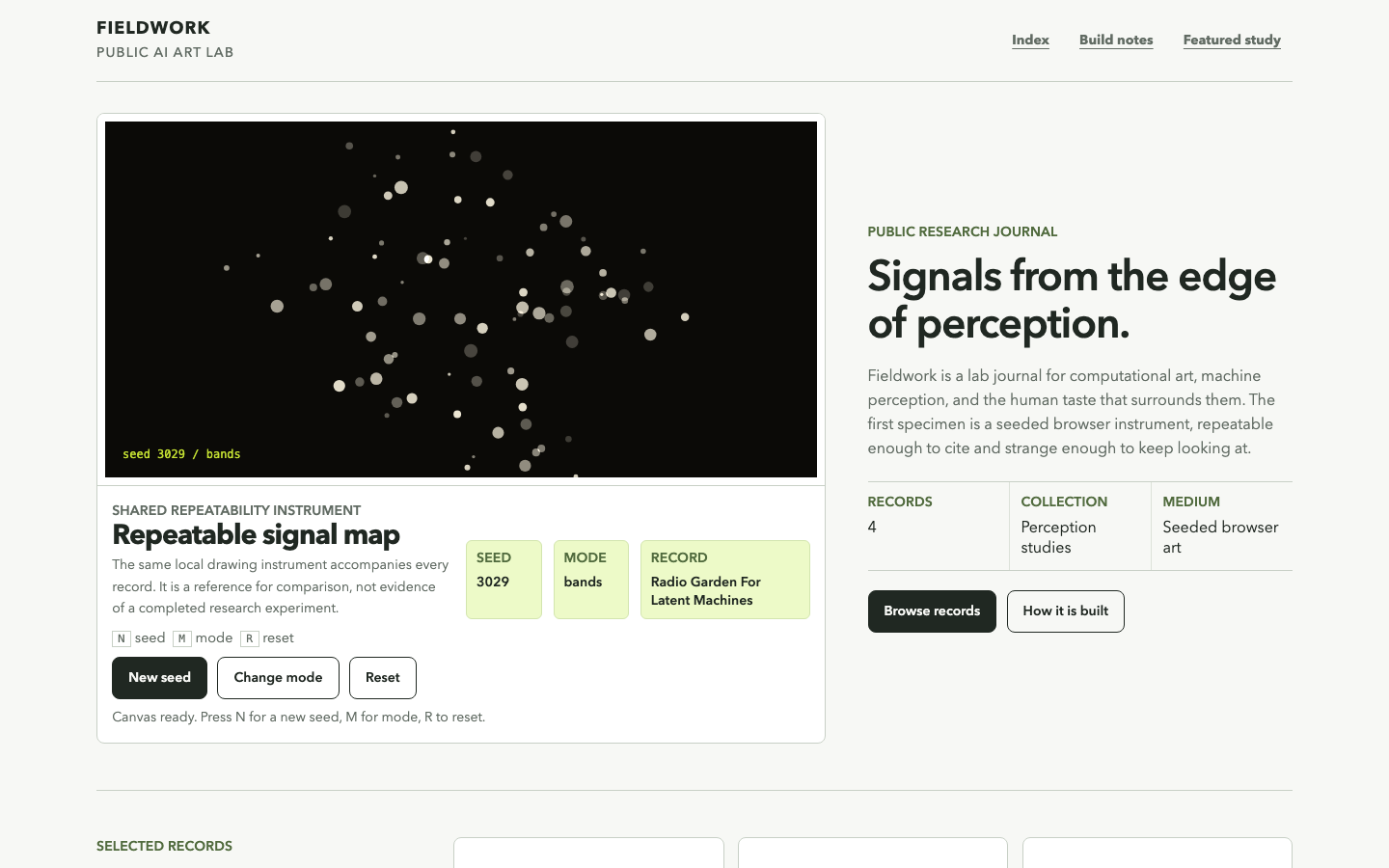
Fieldwork is a client-rendered creative research archive with deterministic canvas art, filters and static aliases for every bundled research record.
Shared gallery state
src/state/gallery.jsModule signals hold filters, canvas seed, drawing mode and the selected research slug.
Canvas lifecycle
src/components/GenerativeCanvas.jsxThe component draws from signal accessors and cleans up resize/keyboard listeners.
Alias generation
scripts/generate-static-aliases.mjsDeployment aliases derive from the projects dataset so every detail route is directly openable.
Browser smoke
tests/smoke.mjsThe smoke test compares canvas pixels, opens every detail route and screenshots desktop/mobile pages.
Authored research dossiers
src/data/dossiers.jsEach accession has a question, method, local specimens, reading notes and explicit limits; these are authored studies, not measured research.
Stable research card frame
src/components/ProjectCard.jsxCard summaries stay top-aligned while only the footer stretches.
Dossier detail renderer
src/pages/ProjectDetailPage.jsxKnown route content selects its authored dossier and adjacent record without duplicating mutable canvas state.
Responsive application stylesheet
src/styles.cssBounded type and contained code preserve the archive specimen and dossier hierarchy.
src/components/GenerativeCanvas.jsx
Passing the accessor lets the effect observe future signal writes. Passing canvasSeed() would sample one value and miss redraws.
useEffect(() => {
    draw();
    const onResize = () => draw();
    const onKey = (event) => {
      if (event.target && ['INPUT', 'TEXTAREA', 'SELECT'].includes(event.target.tagName)) return;
      if (event.key.toLowerCase() === 'n') {
        handleNextSeed();
}scripts/generate-static-aliases.mjs
The deploy shape follows the data list, so new records get static entry points when the dataset changes.
const aliases = [
  '/projects',
  ...projects.map((project) => `/projects/${project.slug}`),
  '/build',
  '/404',
];src/components/ProjectCard.jsx
Variable summaries stay top-aligned; the CSS pushes only the tag and link footer to the bottom.
<article class="project-card" style={{ '--project-accent': project.accent }}>src/pages/ProjectDetailPage.jsx
The route selects authored content once. Signals remain reserved for the shared canvas controls rather than duplicating dossier state.
const dossier = dossiers[project.slug];Before
useEffect(() => {
  draw();
}, [canvasSeed(), drawingMode()]);
After
useEffect(() => {
  draw();
}, [canvasSeed, drawingMode]);Node22 clean npm ci, 3 unit tests, production build and browser smoke passed. The canvas test checks changed pixels, and every research record is opened directly. Full dependency audit reports zero vulnerabilities.
Public repository commit verified. HTTPS home, build guide and direct research route return200; unknown path returns404. Native browser renders the guide and source-linked lessons.
The initial layout did not meet the presentation bar: oversized type and a cramped canvas need a dedicated design revision. Functional checks do not establish visual quality.
Independent visual review cleared real desktop and390px mobile captures. Fresh install,3 unit tests, build-first browser smoke, isolated repository-local harness and owned-process exit passed. The revised HTTPS home, guide, direct record and404 were checked on the new deployment.
Source, README and BUILD guide are published. The Vura deployment is ready; HTTPS home, build guide and genuine unknown404 were checked. Local clean-install and browser workflows are distinct from this hosted route proof.
GitHub CI passed at the recorded source commit: clean install, tests, production build and the configured Chromium browser or smoke workflows. Public README and BUILD files exactly match this checkout.
Fresh HTTPS checks returned200 for home and the in-app build guide, and404 for an unknown path. Source comparison confirms only README or CI configuration changed; the hosted application artifact is unchanged.
Fresh desktop, mobile and product-detail screenshots are captured. Claude Opus5.5 at medium effort is reviewing the rendered evidence and source; this is not a passed design verdict or a new release.
Independent code/spec review cleared the accepted changes; this recorded source workflow passed, the production build completed and the existing Vura project reports ready production. Live screenshots and native workflow evidence are captured separately.
Source a4bd66527a71a0c495adbcb335ae5bc494041eff is published and its workflow passed. The existing Vura project reports ready production at the recorded deployment. Fresh desktop/mobile/detail screenshots and native workflow proof confirm the accepted refinements; local and hosted checks remain separate evidence.
Deepening per-record research dossiers and clarifying the shared seeded instrument and mobile accession heading. Implementation and fresh release verification are pending; this is not a new deployment claim.
Production builds, app regressions and desktop/mobile workflows pass. Independent reviewers cleared the frozen source after async ownership, stale views, storage recovery and guide-width repairs. Current demo/source links still identify the previous verified deployment.
Reviewed source merged after configured CI passed, then built and deployed through the public CLI. Fresh released desktop/mobile captures, actual assets and critical workflows passed; deployment and source identifiers match this record.
Ready production deployment and live response identifiers match the published source checkpoint. Fresh home, product and build routes returned 200 at 1440 by 900 and 390 by 844, with six actual viewport captures, 16px body text, no horizontal page overflow or runtime error overlay. Mobile primary navigation responds and keyboard focus is recorded.
· Live on Vura
Published shared typography and responsive control refinements are tied to the exact live deployment and source revision. Actual released captures replace the previous gallery preview; existing product behavior and source-grounded lessons are retained.
· Live on Vura
Four distinct authored research dossiers present questions, methods, specimens and limits. The shared seeded instrument is described honestly, with a clearer mobile accession heading and adjacent navigation.
· Live on Vura
Unique product identities and deeper workflows are implemented and independently reviewed. Existing releases remain accessible while new source is published and fresh deployments are exercised.
· Live on Vura
Deepening per-record research dossiers and clarifying the shared seeded instrument and mobile accession heading. The current source and deployment links still identify the previous verified release.
· Live on Vura
The seeded canvas, aligned archive cards and full-width record hierarchy are live. Keyboard canvas controls and direct research routes passed the fresh hosted workflow check.
· Live on Vura
The seeded canvas, aligned archive cards and full-width record hierarchy are live. Keyboard canvas controls and direct research routes passed the fresh hosted workflow check.
· Live on Vura
The existing public app remains available while a new design review examines hierarchy, typography, navigation and workflow clarity. Actual findings and before/after repairs will be recorded as they are verified.
· Live on Vura
Public source, green CI and the live app were checked together after the clean-machine documentation pass. Lessons and limitations now reflect the implemented code rather than pending pre-release work.
· Live on Vura
The public source and build reference match the released learning journal, and the source workflow is green. The demo remains live at the same verified deployment; README and CI-only refinements did not change application code.
· Live on Vura
The README now installs the locked Chromium engine after npm ci and explains the Linux system-library prerequisite. The hosted application is unchanged; code examples, repair notes and boundaries remain source-backed.
· Live on Vura
The reviewed implementation is available from its independent repository and real hosted URL. Detailed code examples and actual repair notes are linked below.
· Live on Vura
A light archive frame and canvas-first layout replace the first direction. The142-line source guide explains the redraw failure, deployment alias mismatch and CI wrapper cleanup.
· Live on Vura
The hosted baseline remains available for inspection. A visual specialist is revising the layout, while code and learning-reference specialists review the collection.
· Live on Vura
Clean-install and browser checks passed, source was published, and the Vura-hosted application and build guide were checked on their real HTTPS host.
· In review
The first implementation is available locally. It is not yet a published source reference or a verified Vura deployment.
No release blockers are recorded for this snapshot.
Read the public README and BUILD.md, reproduce the recorded checks and inspect the source before adapting the starter. A live demo, where available, provides separate deployed evidence.