Planner store
src/state/planner.jsSignals hold filters, weekly plan and serving overrides; computed values derive meals, stats and grocery totals.
Lifestyle starter
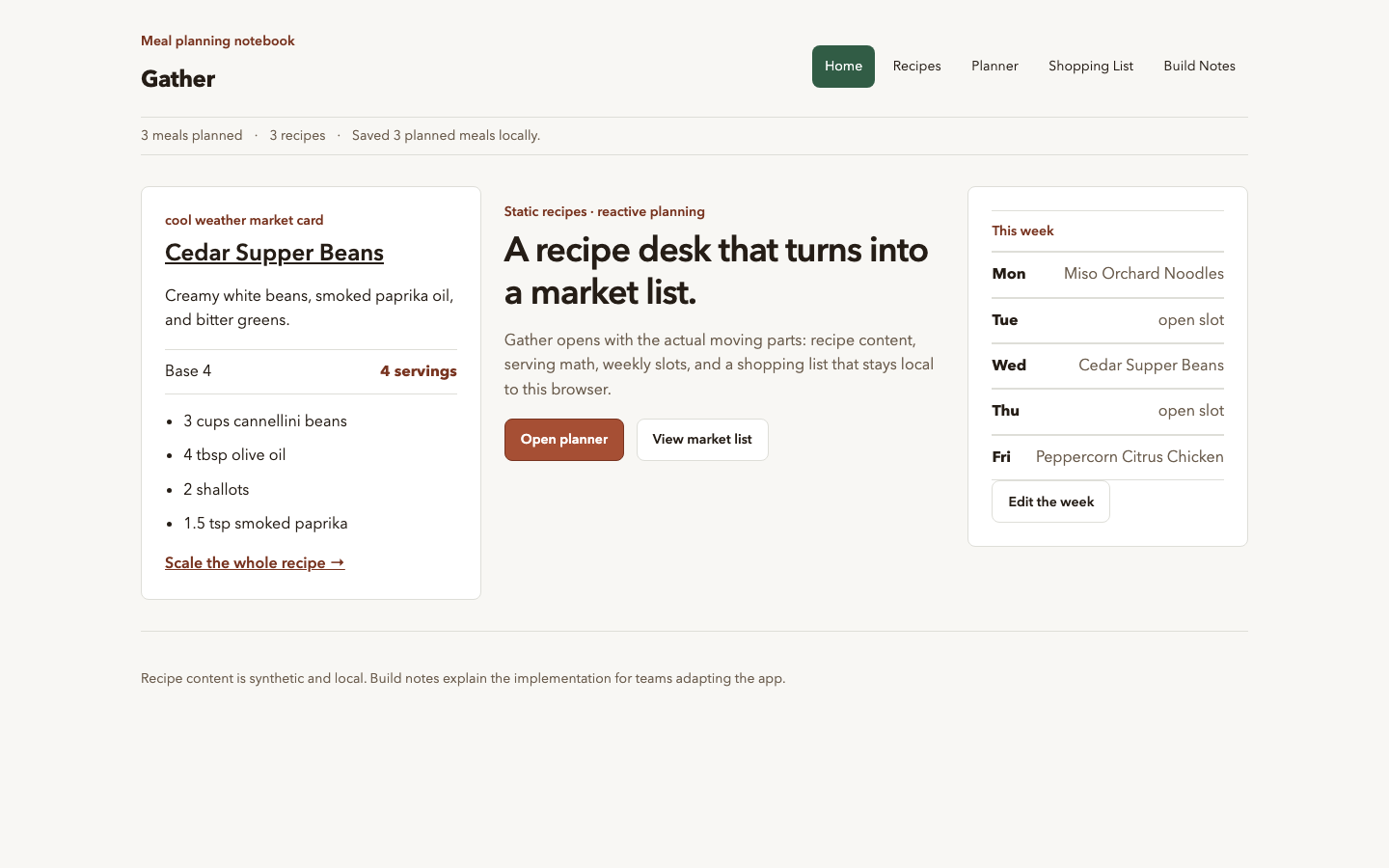
A seasonal recipe collection with practical meal planning and a shopping list.
Ingredient checks persist across routes and reload, with remaining counts and clear controls independent of meal planning. The terracotta recipe and market notebook remains browser-local.
This tracks the recorded release phase. The checks below include later findings and ongoing refinements.
The following describes the intended reference. Features are not a verification claim; recorded check results below define what has actually been tested.
Client-rendered application served from explicit static route entries; browser-local state, not a shared server database.
Gather is a recipe and meal-planning starter with static recipe routes, client filters, scaled servings and a derived shopping list.
Planner store
src/state/planner.jsSignals hold filters, weekly plan and serving overrides; computed values derive meals, stats and grocery totals.
Static aliases
scripts/static-aliases.mjsRecipe detail routes and private planner routes are emitted as concrete Vura pages.
Build page
src/pages/Build.jsxThe guide explains local state, routing and generated aliases for agents.
Recipe day selection
src/pages/RecipeDetail.jsxA mount-local selected day feeds explicit planner actions rather than hard-coded destinations.
Responsive application stylesheet
src/styles.cssSize the wrapping checkbox label; six equal mobile tracks balance three links above two.
src/pages/RecipeDetail.jsx
The detail page starts on the first empty day but keeps the chosen day as local component state.
const selectedDay = signal(firstOpenDay(), `gather.detailDay.${recipe.slug}`);src/state/planner.js
The shopping list is not separately editable state. It is a projection of planned meals plus serving overrides.
const existing = totals.get(key) || { item: ingredient.item, unit: ingredient.unit, amount: 0, recipes: new Set() };scripts/static-aliases.mjs
Dataset-driven aliases prevent the static host from treating a known recipe URL like an unknown SPA fallback.
...recipes.map((recipe) => [src/state/planner.js
Checked keys survive navigation and reload; progress counts only keys in the current computed market list.
export const ingredientKey = (ingredient) => `${ingredient.item}|${ingredient.unit}`;Local implementation reported complete. Independent check results and public release evidence have not been recorded here yet.
Actual desktop and mobile screenshots were reviewed after domain-specific layout refinements. Final review cleared the presentation; functional hosting checks remain separate.
Source, README and BUILD guide are published. The Vura deployment is ready; HTTPS home, build guide and genuine unknown404 were checked. Local clean-install and browser workflows are distinct from this hosted route proof.
GitHub CI passed at the recorded source commit: clean install, tests, production build and the configured Chromium browser or smoke workflows. Public README and BUILD files exactly match this checkout.
Fresh HTTPS checks returned200 for home and the in-app build guide, and404 for an unknown path. Source comparison confirms only README or CI configuration changed; the hosted application artifact is unchanged.
Fresh desktop, mobile and product-detail screenshots are captured. Claude Opus5.5 at medium effort is reviewing the rendered evidence and source; this is not a passed design verdict or a new release.
Independent code/spec review cleared the accepted changes; this recorded source workflow passed, the production build completed and the existing Vura project reports ready production. Live screenshots and native workflow evidence are captured separately.
Source 68972b5eb8e3ab375c99dd80ad25891b4ebe29f4 is published and its workflow passed. The existing Vura project reports ready production at the recorded deployment. Fresh desktop/mobile/detail screenshots and native workflow proof confirm the accepted refinements; local and hosted checks remain separate evidence.
Persisting ingredient checklist state across navigation, with remaining counts and clear controls. Implementation and fresh release verification are pending; this is not a new deployment claim.
Production builds, app regressions and desktop/mobile workflows pass. Independent reviewers cleared the frozen source after async ownership, stale views, storage recovery and guide-width repairs. Current demo/source links still identify the previous verified deployment.
Reviewed source merged after configured CI passed, then built and deployed through the public CLI. Fresh released desktop/mobile captures, actual assets and critical workflows passed; deployment and source identifiers match this record.
Ready production deployment and live response identifiers match the published source checkpoint. Fresh home, product and build routes returned 200 at 1440 by 900 and 390 by 844, with six actual viewport captures, 16px body text, no horizontal page overflow or runtime error overlay. Mobile primary navigation responds and keyboard focus is recorded.
· Live on Vura
Published shared typography and responsive control refinements are tied to the exact live deployment and source revision. Actual released captures replace the previous gallery preview; existing product behavior and source-grounded lessons are retained.
· Live on Vura
Ingredient checks persist across routes and reload, with remaining counts and clear controls independent of meal planning. The terracotta recipe and market notebook remains browser-local.
· Live on Vura
Unique product identities and deeper workflows are implemented and independently reviewed. Existing releases remain accessible while new source is published and fresh deployments are exercised.
· Live on Vura
Persisting ingredient checklist state across navigation, with remaining counts and clear controls. The current source and deployment links still identify the previous verified release.
· Live on Vura
Recipe planning now selects a day and rejects a full or duplicate slot. Serving controls, planning persistence and recipe routes passed the live workflow check.
· Live on Vura
Recipe planning now selects a day and rejects a full or duplicate slot. Serving controls, planning persistence and recipe routes passed the live workflow check.
· Live on Vura
The existing public app remains available while a new design review examines hierarchy, typography, navigation and workflow clarity. Actual findings and before/after repairs will be recorded as they are verified.
· Live on Vura
Public source, green CI and the live app were checked together after the clean-machine documentation pass. Lessons and limitations now reflect the implemented code rather than pending pre-release work.
· Live on Vura
The public source and build reference match the released learning journal, and the source workflow is green. The demo remains live at the same verified deployment; README and CI-only refinements did not change application code.
· Live on Vura
The README now installs the locked Chromium engine after npm ci and explains the Linux system-library prerequisite. The hosted application is unchanged; code examples, repair notes and boundaries remain source-backed.
· Live on Vura
The reviewed implementation is available from its independent repository and real hosted URL. Detailed code examples and actual repair notes are linked below.
· In review
The local implementation is complete and revised visual evidence has passed review. Source and demo links will appear only after publication and hosted verification.
· In review
The first implementation is available locally. It is not yet a published source reference or a verified Vura deployment.
No release blockers are recorded for this snapshot.
Read the public README and BUILD.md, reproduce the recorded checks and inspect the source before adapting the starter. A live demo, where available, provides separate deployed evidence.