Operations store
src/state/ops.jsModule signals hold overrides, filters, saved views, log entries and save status.
Operations starter
A calm operations console for coordinating projects, tasks and team work.
Incident quick actions update visible controls and activity; restored saved views are validated and deduplicated. The industrial console is compact on mobile and remains a browser-local simulation.
This tracks the recorded release phase. The checks below include later findings and ongoing refinements.
The following describes the intended reference. Features are not a verification claim; recorded check results below define what has actually been tested.
Client-rendered application served from explicit static route entries; browser-local state, not a shared server database.
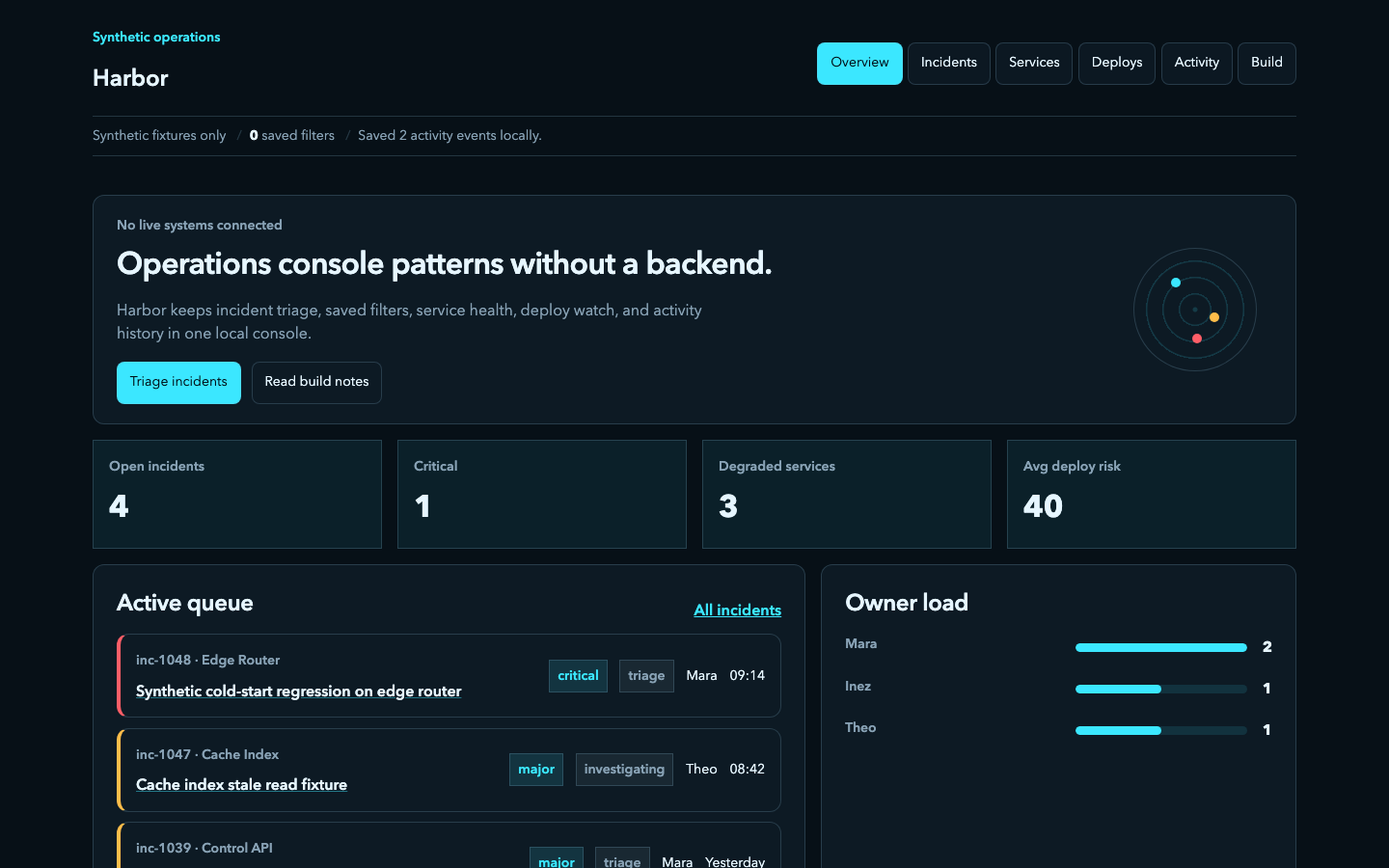
Harbor is an operations console reference for filters, incident overrides, saved views, activity logs and routeable detail pages.
Operations store
src/state/ops.jsModule signals hold overrides, filters, saved views, log entries and save status.
Routes
src/routes.jsThe app includes overview, incidents, services, deploys, activity, build and incident-detail routes.
Build page
src/pages/Build.jsxThe in-app guide names local-only persistence and generated static aliases.
Reactive incident detail
src/pages/IncidentDetail.jsxThe route id is stable setup; the current merged incident is read through an accessor for selects, severity and quick actions.
Responsive application stylesheet
src/styles.cssThe incident detail grid uses start alignment with shared heading and control scales.
src/state/ops.js
The seed incident data stays unchanged; user edits live in a separate signal keyed by incident id.
export const mergedIncidents = computed(() => incidents.map((incident) => ({ ...incident, ...(incidentOverrides()[incident.id] || {}) })));src/state/ops.js
The UI receives risk tone and bounded meter style from one computed read model instead of rebuilding thresholds in cards.
export const deployRollups = computed(() => deploys.map((deploy) => ({
  ...deploy,
  serviceName: serviceName(deploy.serviceId),
  linkedIncidents: mergedIncidents().filter((incident) => incident.serviceId === deploy.serviceId && incident.status !== 'resolved').length,
  tone: deployRiskTone(deploy.risk),
  meterStyle: riskMeterStyle(deploy.risk)
})));src/pages/IncidentDetail.jsx
A run-once component can capture a stable route id; editable record reads belong in an accessor used by reactive bindings.
const incidentId = route.params.id;
const incident = () => mergedIncidents().find((entry) => entry.id === incidentId);src/styles.css
The incident detail grid uses start alignment with shared heading and control scales.
.detail-grid {
  display: grid;
  grid-template-columns: minmax(260px, 0.8fr) minmax(300px, 1.2fr);
  gap: 1rem;
  align-items: start;
}Local implementation reported complete. Independent check results and public release evidence have not been recorded here yet.
Actual desktop and mobile screenshots were reviewed after domain-specific layout refinements. Final review cleared the presentation; functional hosting checks remain separate.
Source, README and BUILD guide are published. The Vura deployment is ready; HTTPS home, build guide and genuine unknown404 were checked. Local clean-install and browser workflows are distinct from this hosted route proof.
GitHub CI passed at the recorded source commit: clean install, unit tests, production build, route smoke and desktop/mobile browser flows. The matching official Playwright image includes Chromium and WebKit; no tests were removed.
Fresh HTTPS checks returned200 for home and the in-app build guide, and404 for an unknown path. Source comparison confirms only README or CI configuration changed; the hosted application artifact is unchanged.
Fresh desktop, mobile and product-detail screenshots are captured. Claude Opus5.5 at medium effort is reviewing the rendered evidence and source; this is not a passed design verdict or a new release.
Independent code/spec review cleared the accepted changes; this recorded source workflow passed, the production build completed and the existing Vura project reports ready production. Live screenshots and native workflow evidence are captured separately.
Source 3d66fdf519082e91ca9722b3dcbe08c1293c2720 is published and its workflow passed. The existing Vura project reports ready production at the recorded deployment. Fresh desktop/mobile/detail screenshots and native workflow proof confirm the accepted refinements; local and hosted checks remain separate evidence.
Repairing stale incident controls after saved quick actions and making saved filters distinguishable. Implementation and fresh release verification are pending; this is not a new deployment claim.
Production builds, app regressions and desktop/mobile workflows pass. Independent reviewers cleared the frozen source after async ownership, stale views, storage recovery and guide-width repairs. Current demo/source links still identify the previous verified deployment.
Reviewed source merged after configured CI passed, then built and deployed through the public CLI. Fresh released desktop/mobile captures, actual assets and critical workflows passed; deployment and source identifiers match this record.
Ready production deployment and live response identifiers match the published source checkpoint. Fresh home, product and build routes returned 200 at 1440 by 900 and 390 by 844, with six actual viewport captures, 16px body text, no horizontal page overflow or runtime error overlay. Mobile primary navigation responds and keyboard focus is recorded.
· Live on Vura
Published shared typography and responsive control refinements are tied to the exact live deployment and source revision. Actual released captures replace the previous gallery preview; existing product behavior and source-grounded lessons are retained.
· Live on Vura
Incident quick actions update visible controls and activity; restored saved views are validated and deduplicated. The industrial console is compact on mobile and remains a browser-local simulation.
· Live on Vura
Unique product identities and deeper workflows are implemented and independently reviewed. Existing releases remain accessible while new source is published and fresh deployments are exercised.
· Live on Vura
Repairing stale incident controls after saved quick actions and making saved filters distinguishable. The current source and deployment links still identify the previous verified release.
· Live on Vura
The operations console now foregrounds its queue, status colors and data-backed risk/load meters; incident titles and severity rails have readable spacing.
· Live on Vura
The operations console now foregrounds its queue, status colors and data-backed risk/load meters; incident titles and severity rails have readable spacing.
· Live on Vura
The existing public app remains available while a new design review examines hierarchy, typography, navigation and workflow clarity. Actual findings and before/after repairs will be recorded as they are verified.
· Live on Vura
Public source, green CI and the live app were checked together after the clean-machine documentation pass. Lessons and limitations now reflect the implemented code rather than pending pre-release work.
· Live on Vura
The public source and build reference match the released learning journal, and the source workflow is green. The demo remains live at the same verified deployment; README and CI-only refinements did not change application code.
· Live on Vura
The README installs the locked Chromium and WebKit engines after npm ci. Linux CI uses the matching official browser image, avoiding repeated cold browser downloads. These source-only changes leave the hosted application unchanged.
· Live on Vura
The mobile CI job now installs its configured WebKit engine and allows the cold browser setup to complete; application behavior and the hosted artifact are unchanged.
· Live on Vura
The reviewed implementation is available from its independent repository and real hosted URL. Detailed code examples and actual repair notes are linked below.
· In review
The local implementation is complete and revised visual evidence has passed review. Source and demo links will appear only after publication and hosted verification.
· In review
The first implementation is available locally. It is not yet a published source reference or a verified Vura deployment.
No release blockers are recorded for this snapshot.
Read the public README and BUILD.md, reproduce the recorded checks and inspect the source before adapting the starter. A live demo, where available, provides separate deployed evidence.