Audio engine
src/audio/engine.jsA single startGeneration and startingPromise coordinate async AudioContext startup.
Creative starter
A browser music sketchbook for building patterns and exploring sound.
Saved/custom pattern identity, guarded storage failure and numerical controls match the instrument state. The playable sequencer appears much earlier on mobile; audio ownership and guide containment pass.
This tracks the recorded release phase. The checks below include later findings and ongoing refinements.
The following describes the intended reference. Features are not a verification claim; recorded check results below define what has actually been tested.
Client-rendered application served from explicit static route entries; browser-local state, not a shared server database.
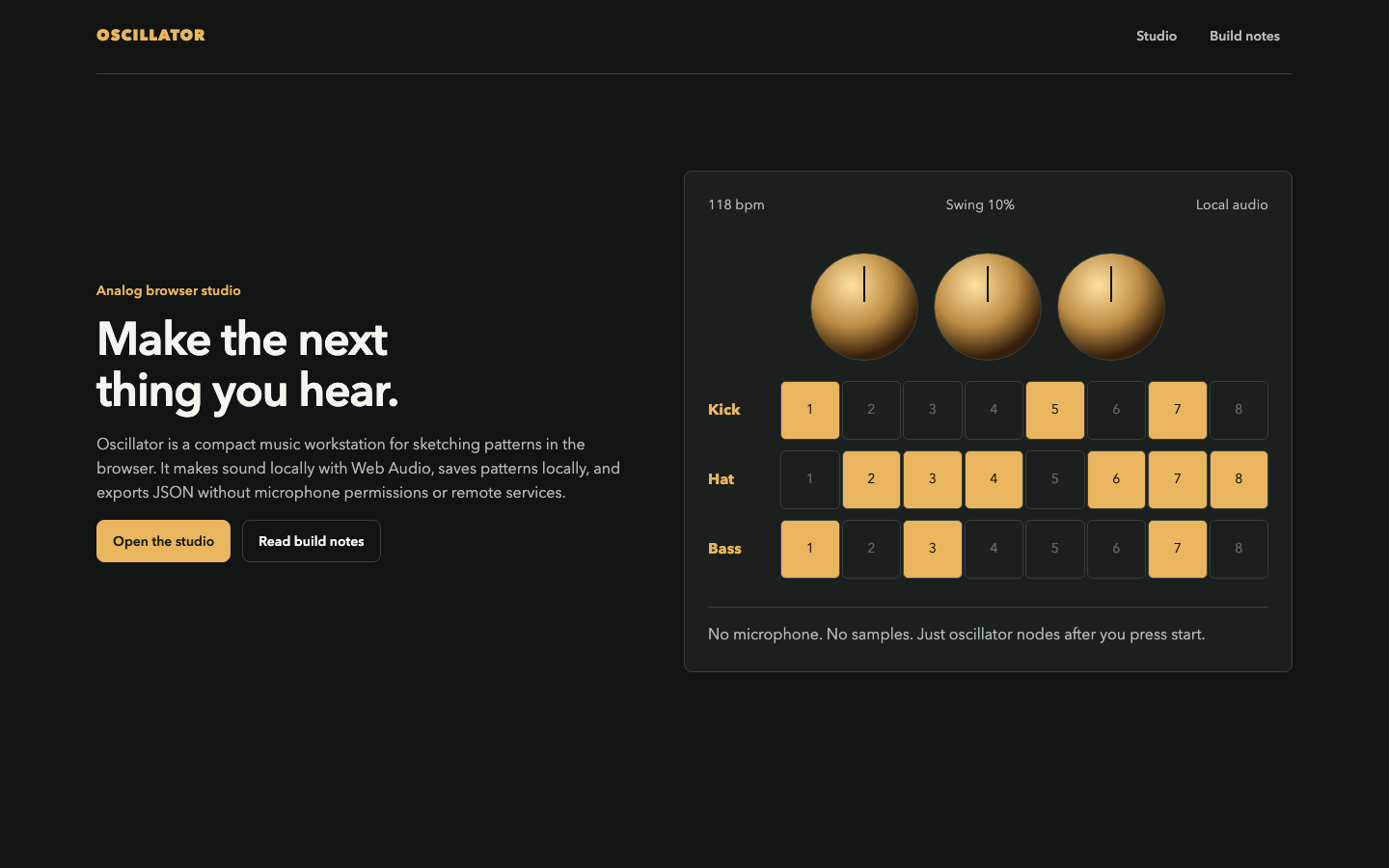
Oscillator is a browser music studio that demonstrates global pattern state, Web Audio lifecycle cleanup and routeable studio/build pages.
Audio engine
src/audio/engine.jsA single startGeneration and startingPromise coordinate async AudioContext startup.
Lifecycle tests
src/audio/engine.lifecycle.test.jsTests cover duplicate starts, stop-before-resume and dispose-before-resume races.
Studio state
src/state/studio.jsSignals store pattern, playback state, current step and user-facing audio status.
Pattern identity regression
src/state/studio.test.jsTests restore saved presets, identify custom edits and exercise denied save/reset operations.
Sequencer grid
src/components/Sequencer.jsxThe step ruler owns its grid and the playhead is visible only during playback.
Responsive application stylesheet
src/styles.cssMobile steps and ruler share four columns; transport controls retain their numeric readouts.
src/audio/engine.js
Repeated Start clicks before AudioContext.resume() resolves share the same promise instead of creating duplicate intervals.
if (startingPromise) {
    audioStatus('Audio starting.');
    return startingPromise;
  }
  if (!isAudioSupported()) {
    browserError('This browser does not expose Web Audio. Try a current Chromium, Safari, or Firefox build.');
return;src/audio/engine.lifecycle.test.js
The regression test models the exact race: the user stops playback while browser audio permission is still resolving.
const pendingStart = startEngine();src/components/Sequencer.jsx
The stopped studio keeps selected steps visible without leaving a fake current-step highlight on the grid.
isPlaying() && currentStep() === step && 'playing',src/state/studio.js
The restored pattern, not a hard-coded first-preset id, determines the selected preset. An edited patch has custom identity.
export const currentPresetId = computed(() => presets.find((preset) => JSON.stringify(preset) === JSON.stringify(pattern()))?.id || '');Local implementation reported complete. Independent check results and public release evidence have not been recorded here yet.
Actual desktop and mobile screenshots were reviewed after domain-specific layout refinements. Final review cleared the presentation; functional hosting checks remain separate.
Source, README and BUILD guide are published. The Vura deployment is ready; HTTPS home, build guide and genuine unknown404 were checked. Local clean-install and browser workflows are distinct from this hosted route proof.
GitHub CI passed at the recorded source commit: clean install, tests, production build and the configured Chromium browser or smoke workflows. Public README and BUILD files exactly match this checkout.
Fresh HTTPS checks returned200 for home and the in-app build guide, and404 for an unknown path. Source comparison confirms only README or CI configuration changed; the hosted application artifact is unchanged.
Fresh desktop, mobile and product-detail screenshots are captured. Claude Opus5.5 at medium effort is reviewing the rendered evidence and source; this is not a passed design verdict or a new release.
Independent code/spec review cleared the accepted changes; this recorded source workflow passed, the production build completed and the existing Vura project reports ready production. Live screenshots and native workflow evidence are captured separately.
Source a441f9fe97604ed90b2b04bf495bf19bc9cd2516 is published and its workflow passed. The existing Vura project reports ready production at the recorded deployment. Fresh desktop/mobile/detail screenshots and native workflow proof confirm the accepted refinements; local and hosted checks remain separate evidence.
Repairing denied-storage feedback and saved-pattern identity, with the sequencer earlier on mobile. Implementation and fresh release verification are pending; this is not a new deployment claim.
Production builds, app regressions and desktop/mobile workflows pass. Independent reviewers cleared the frozen source after async ownership, stale views, storage recovery and guide-width repairs. Current demo/source links still identify the previous verified deployment.
Reviewed source merged after configured CI passed, then built and deployed through the public CLI. Fresh released desktop/mobile captures, actual assets and critical workflows passed; deployment and source identifiers match this record.
Ready production deployment and live response identifiers match the published source checkpoint. Fresh home, product and build routes returned 200 at 1440 by 900 and 390 by 844, with six actual viewport captures, 16px body text, no horizontal page overflow or runtime error overlay. Mobile primary navigation responds and keyboard focus is recorded. The desktop home hero measures 56px, exceeding the 48px heading target; this styling exception remains open.
The previously reported 56px desktop hero is closed by the released stylesheet repair. Fresh home, studio and build routes returned 200 at 1440 by 900 and 390 by 844 with the exact new deployment identifier. Home heading measures 48px on desktop and 32px on mobile; body text remains 16px and brand targets meet 44px. No horizontal page overflow, framework overlay, pageerror or console error occurred. Home-to-studio navigation responds with a visible 2px keyboard focus outline. The actual released desktop PNG is the replacement gallery preview.
· Live on Vura
The historical 56px finding is retained. A narrow stylesheet repair now caps the released home heading at 48px while preserving the 32px mobile heading, studio controls and audio state. Fresh production route captures and navigation checks identify the new source and deployment checkpoint.
· Live on Vura
Published shared typography and responsive control refinements are tied to the exact live deployment and source revision. Actual released captures replace the previous gallery preview; existing product behavior and source-grounded lessons are retained. The desktop home hero measures 56px, exceeding the 48px heading target; this styling exception remains open.
· Live on Vura
Saved/custom pattern identity, guarded storage failure and numerical controls match the instrument state. The playable sequencer appears much earlier on mobile; audio ownership and guide containment pass.
· Live on Vura
Unique product identities and deeper workflows are implemented and independently reviewed. Existing releases remain accessible while new source is published and fresh deployments are exercised.
· Live on Vura
Repairing denied-storage feedback and saved-pattern identity, with the sequencer earlier on mobile. The current source and deployment links still identify the previous verified release.
· Live on Vura
The studio has a genuine16-step ruler, compact track controls and an honest stopped playhead. Live step toggling passed a clean browser retry.
· Live on Vura
The studio has a genuine16-step ruler, compact track controls and an honest stopped playhead. Live step toggling passed a clean browser retry.
· Live on Vura
The existing public app remains available while a new design review examines hierarchy, typography, navigation and workflow clarity. Actual findings and before/after repairs will be recorded as they are verified.
· Live on Vura
Public source, green CI and the live app were checked together after the clean-machine documentation pass. Lessons and limitations now reflect the implemented code rather than pending pre-release work.
· Live on Vura
The public source and build reference match the released learning journal, and the source workflow is green. The demo remains live at the same verified deployment; README and CI-only refinements did not change application code.
· Live on Vura
The README now installs the locked Chromium engine after npm ci and explains the Linux system-library prerequisite. The hosted application is unchanged; code examples, repair notes and boundaries remain source-backed.
· Live on Vura
The reviewed implementation is available from its independent repository and real hosted URL. Detailed code examples and actual repair notes are linked below.
· In review
The local implementation is complete and revised visual evidence has passed review. Source and demo links will appear only after publication and hosted verification.
· In review
The first implementation is available locally. It is not yet a published source reference or a verified Vura deployment.
No release blockers are recorded for this snapshot.
Read the public README and BUILD.md, reproduce the recorded checks and inspect the source before adapting the starter. A live demo, where available, provides separate deployed evidence.