Cached server page
src/pages/index.tsxThe page exports server mode, revalidation, tags, loader data and SSR markup.
Operations starter
A service status site for communicating incidents and explaining operational health.
Both incident detail routes render, request loaders use real timestamps and the stylesheet is served correctly. Cached overview and private uncached snapshot behavior passed live proof.
This tracks the recorded release phase. The checks below include later findings and ongoing refinements.
The following describes the intended reference. Features are not a verification claim; recorded check results below define what has actually been tested.
Request-time SSR, a cached overview, static reference pages and a real serverless health API; simulated service data.
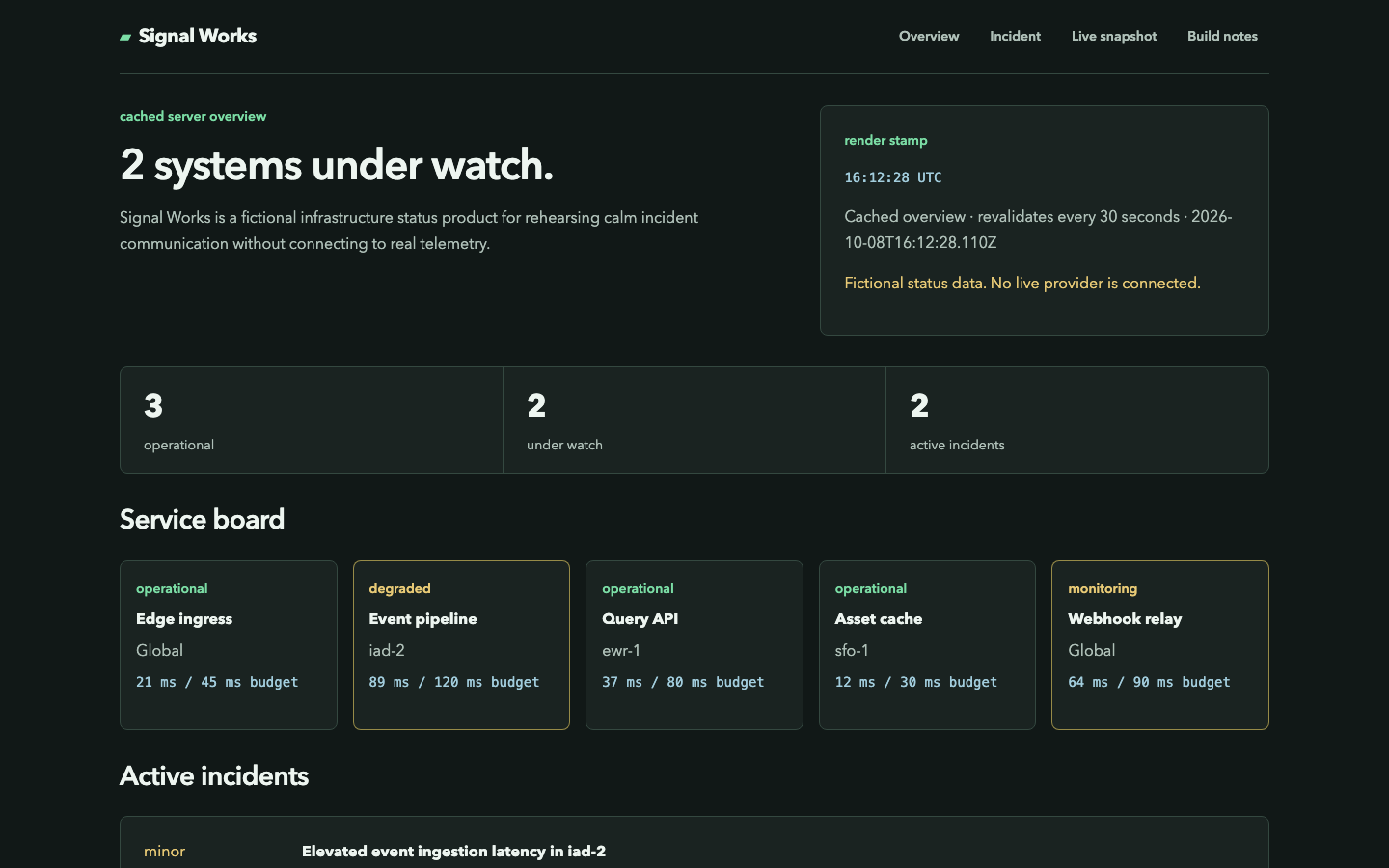
Signal is a Vura server-rendered status page showing cached output, page config and a small serverless health route.
Cached server page
src/pages/index.tsxThe page exports server mode, revalidation, tags, loader data and SSR markup.
Function route
src/api/health.tsThe health API declares serverless compute and returns JSON through the Vura reply object.
Private request-time snapshot
src/pages/snapshot.tsxThe snapshot reads fresh loader data without public revalidation, contrasting the cached overview.
Build guide
src/pages/build.tsxThe public guide documents useLoaderData, literal head strings and local CSS delivery checks.
Second incident server route
src/pages/incidents/webhook-retry-spike.tsxLiteral server configuration and a typed loader make the second advertised incident directly addressable.
Responsive application stylesheet
src/site/styles.cssThe source stylesheet supplies readable status copy, 44px navigation and contained monospace readouts.
src/pages/index.tsx
The cache contract is near the page, not hidden in deployment notes.
const { renderedAt, summary } = useLoaderData<typeof loader>();src/api/health.ts
Vura can see the route shape statically while the handler stays a small typed function.
compute: { class: 'function', memory: '1gb' },src/pages/incidents/webhook-retry-spike.tsx
The component renders shared incident detail from real loader data rather than guessing page props.
const { incident, renderedAt } = useLoaderData<typeof loader>();src/site/styles.css
The source stylesheet supplies readable status copy, 44px navigation and contained monospace readouts.
.brand { display: inline-flex; align-items: center; min-height: 44px; gap: 8px; text-decoration: none; font-weight: 700; font-size: 1.25rem; letter-spacing: -.02em; }Build, targeted tests and browser journeys are reported passing. Independent code, design and clean-consumer verification are still required.
Actual desktop and mobile screenshots were reviewed after domain-specific layout refinements. Final review cleared the presentation; functional hosting checks remain separate.
Source, README and BUILD guide are published. The Vura deployment is ready; HTTPS home, build guide and genuine unknown404 were checked. Local clean-install and browser workflows are distinct from this hosted route proof.
GitHub CI passed at the recorded source commit: clean install, tests, production build and the configured Chromium browser or smoke workflows. Public README and BUILD files exactly match this checkout.
Fresh HTTPS checks returned200 for home and the in-app build guide, and404 for an unknown path. Source comparison confirms only README or CI configuration changed; the hosted application artifact is unchanged.
Fresh desktop, mobile and product-detail screenshots are captured. Claude Opus5.5 at medium effort is reviewing the rendered evidence and source; this is not a passed design verdict or a new release.
The page links styles.css, but public HTTPS returns404 for that CSS asset and the browser uses default unstyled text. The server-rendered timestamp displays unknown; local source diagnosis identified a loader API mismatch.
Independent code/spec review cleared the accepted changes; this recorded source workflow passed, the production build completed and the existing Vura project reports ready production. Live screenshots and native workflow evidence are captured separately.
Public styles.css now returns200 text/css from the recorded deployment; the rendered body is styled. Overview ISO stamps repeat within30seconds, while snapshot stamps change with private/no-store. The prior unknown stamp is absent.
Source 4b8d855c3479476ac2cfe4e7b392e5d2e8a0f761 is published and its workflow passed. The existing Vura project reports ready production at the recorded deployment. Fresh desktop/mobile/detail screenshots and native workflow proof confirm the accepted refinements; local and hosted checks remain separate evidence.
Adding the missing detail route for the second active incident while preserving verified loader and cache behavior. Implementation and fresh release verification are pending; this is not a new deployment claim.
Production builds, app regressions and desktop/mobile workflows pass. Independent reviewers cleared the frozen source after async ownership, stale views, storage recovery and guide-width repairs. Current demo/source links still identify the previous verified deployment.
Reviewed source merged after configured CI passed, then built and deployed through the public CLI. Fresh released desktop/mobile captures, actual assets and critical workflows passed; deployment and source identifiers match this record.
Ready production deployment and live response identifiers match the published source checkpoint. Fresh home, product and build routes returned 200 at 1440 by 900 and 390 by 844, with six actual viewport captures, 16px body text, no horizontal page overflow or runtime error overlay. Mobile primary navigation responds and keyboard focus is recorded.
· Live on Vura
Published shared typography and responsive control refinements are tied to the exact live deployment and source revision. Actual released captures replace the previous gallery preview; existing product behavior and source-grounded lessons are retained.
· Live on Vura
Both incident detail routes render, request loaders use real timestamps and the stylesheet is served correctly. Cached overview and private uncached snapshot behavior passed live proof.
· Live on Vura
Unique product identities and deeper workflows are implemented and independently reviewed. Existing releases remain accessible while new source is published and fresh deployments are exercised.
· Live on Vura
Adding the missing detail route for the second active incident while preserving verified loader and cache behavior. The current source and deployment links still identify the previous verified release.
· Live on Vura
The hosted stylesheet is restored and the page uses the documented loader-data hook. CSS, real ISO stamps, cached overview reuse and private uncached snapshots passed independent live checks.
· Live on Vura
The hosted stylesheet is restored and the page uses the documented loader-data hook. CSS, real ISO stamps, cached overview reuse and private uncached snapshots passed independent live checks.
· Live on Vura
The same build serves its public stylesheet locally, while the hosted CDN omits it. A paired fix will publish public assets through both upload paths and read page loader data through the documented API. Regression and hosted checks are required before calling this repaired.
· Live on Vura
The existing public app remains available while a new design review examines hierarchy, typography, navigation and workflow clarity. Actual findings and before/after repairs will be recorded as they are verified.
· Live on Vura
Public source, green CI and the live app were checked together after the clean-machine documentation pass. Lessons and limitations now reflect the implemented code rather than pending pre-release work.
· Live on Vura
The public source and build reference match the released learning journal, and the source workflow is green. The demo remains live at the same verified deployment; README and CI-only refinements did not change application code.
· Live on Vura
The README now installs the locked Chromium engine after npm ci and explains the Linux system-library prerequisite. The hosted application is unchanged; code examples, repair notes and boundaries remain source-backed.
· Live on Vura
The reviewed implementation is available from its independent repository and real hosted URL. Detailed code examples and actual repair notes are linked below.
· In review
The local implementation is complete and revised visual evidence has passed review. Source and demo links will appear only after publication and hosted verification.
· In review
The implementation owner completed the local build and workflow checks. No public source release or hosted verification is claimed yet.
· Building
The standalone project files exist and the product build is active. No local verification or live release is claimed yet.
· Planned
This is a planned starter, not a working release. Implementation, tests, public source and deployment evidence will be added as they are completed.
No release blockers are recorded for this snapshot.
Read the public README and BUILD.md, reproduce the recorded checks and inspect the source before adapting the starter. A live demo, where available, provides separate deployed evidence.